


Welcome to RealTime Mandarin, a free weekly newsletter that helps you improve your Mandarin in 10 minutes a week.
Subscribe today to get your fluency back, stay informed about China, and communicate with confidence in Chinese — all through immersion in real news.
During the early years of the Qing empire, writers, poets and playwrights obsessed over why the previous dynasty, the Ming (1368 to 1644), had fallen. Their works carried warnings for the new Qing rulers not to repeat the same mistakes made by the corrupt Ming court before them.
The Peach Blossom Fan (桃花扇) is one of those works. It’s a musical play and historical drama written in 1699. It follows the story of two lovers in Nanjing between 1643 and 1645 who are caught up in the factional politics of the last Southern Ming court as it collapses.
In the closing scene of the play, an elderly master who once performed for the Ming elites walks through the ruins of an abandoned palace, and sings:
“I saw him build a high tower, I saw him feast and make merry, but I saw, too, how his tower collapsed.”
眼看他起高楼,眼看他宴宾客,眼看他楼塌了。
The "tower" (楼), which rises and falls, is a metaphor for the fortunes of Ming officials corrupted by wealth and power, and for the dynasty that fell with them.
That line, and the metaphor still survives today.
The “collapsing tower” often describes China’s property sector, which has risen and fallen dramatically over the last two decades, and also for celebrities and business figures who are brought down by scandal.
So when Xu Jiayin (许家印), founder of the indebted property developer Evergrande, was detained three years ago, the line wrote itself: he was a high-profile business celebrity, who lived a life of excess and luxury, and was now at the centre of a collapsing property empire.
That reference was back in the media in the last two weeks, when Xu reappeared in public for the first time in three years.
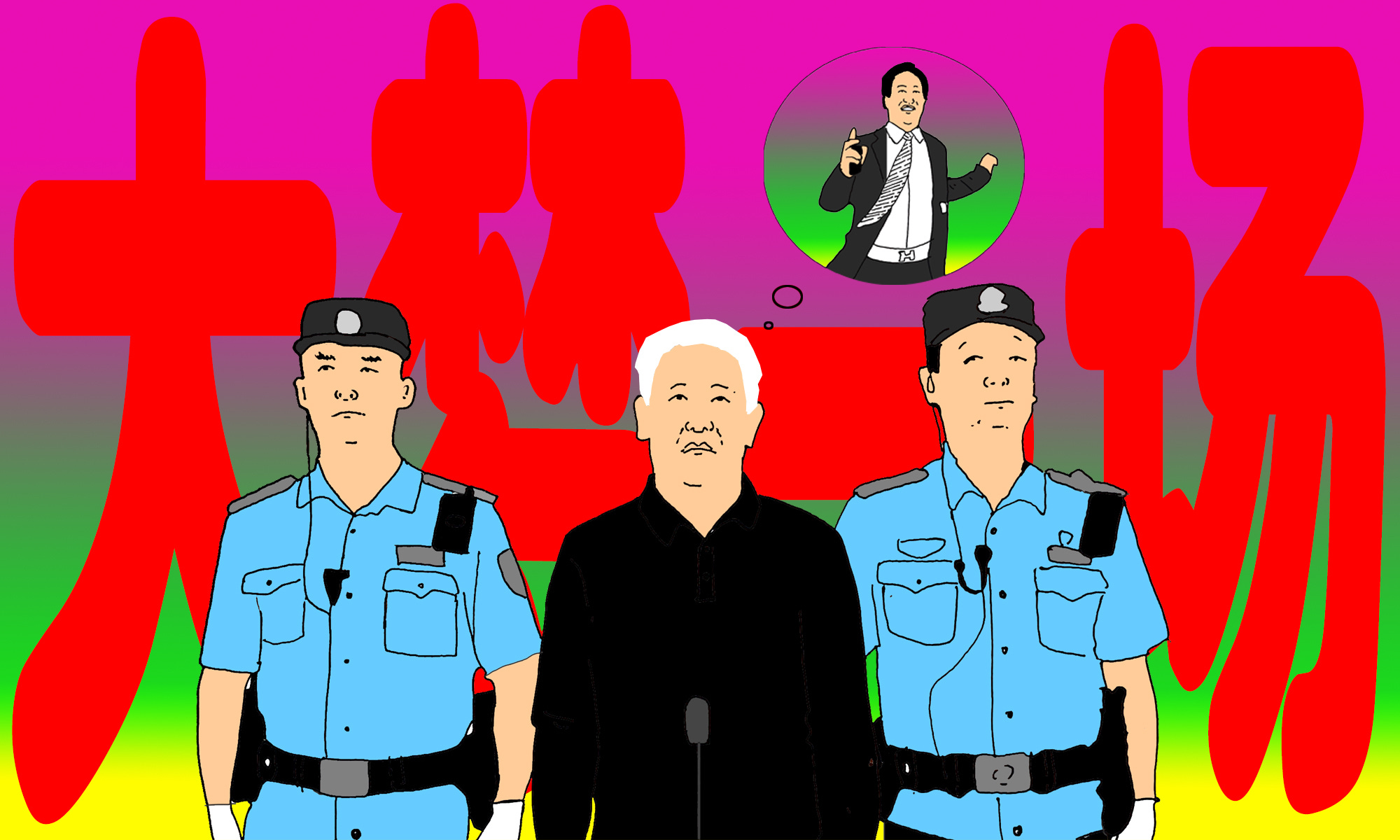
Now with a full head of white hair, Xu Jiayin stood in a Shenzhen courtroom on August 20, flanked by two law enforcement officers. He was sentenced to life imprisonment on eight charges, and ordered to forfeit all of his personal wealth and assets.
“And with that, the man who once stood at the pinnacle of wealth reached his ultimate downfall.”
至此,那个曾经站在财富之巅的男人,彻底迎来了他的终局。 [1]
Related


The arc of Xu Jiayin’s life, from rural poverty to China’s richest man, and now back to nothing, is like an extreme interpretation of the rise and fall of China’s property sector. Fuelled by cheap debt, and by local governments which funded themselves through land sales to companies like Evergrande, China’s real estate market exploded from the early 2000s. Then a major clampdown in 2020 sought to bring developer debt under control, and that eventually brought down both Evergrande and Xu.
Xu Jiayin was born in 1958 in a poor village in Henan. Raised by his grandmother, he went to university shortly after the Cultural Revolution ended when entrance exams were restored. He spent ten years working at a state steel mill in Henan, then left in 1992 to become an entrepreneur with just 20,000 yuan to his name.
He spent his first few years in Shenzhen as a salesman at a trading company, before moving to Guangzhou to run property projects. Evergrande was founded there in 1996. Its first development sold out quickly and made Xu his first real money. Evergrande grew rapidly in the following years and was listed in Hong Kong in 2009.
By 2017 Xu was worth around 280 billion yuan, topping China’s rich list.
He diversified the Evergrande business aggressively, and expensively. His football club, Guangzhou Evergrande (广州恒大), spent hundreds of millions on foreign players and coaches. Evergrande Spring (恒大冰泉), his bottled water brand, burned through 5 billion yuan in three years before being sold off at a loss. And Hengchi (恒驰), an electric car venture, swallowed 47.4 billion yuan and never delivered cars at scale.
The expansion was fuelled by a "game of leverage" (杠杆游戏), which is buying land, mortgaging it, borrowing to build, pre-selling flats, then using the cash to buy more land and bankroll Xu's other expensive ventures.
When Beijing imposed the "three red lines" (三道红线) on property developer borrowing in 2020, Evergrande failed all three and the business began to fall apart. By the end of 2022, the group owed 2.4 trillion yuan to banks, suppliers, and the 1.6 million buyers who had paid for homes which had not yet been built.
Meanwhile, and much like the elites of the late Ming as described in The Peach Blossom Fan, as Xu’s empire was collapsing around him, he was feasting, and funnelling money out of the business, and out of China.
According to court documents, he bought yachts, private jets, luxury cars, a mansion on Hong Kong's Peak, and set up an offshore family trust worth 2.3 billion US dollars. All of it while ordinary savers and homebuyers were losing everything.
Now, less than ten years since he topped China’s rich list, Xu has nothing, and will spend the rest of his life behind bars. One article summed up his life experience with a classical expression:
“He enjoyed thirty years of wealth and glory.
But in the end, it was all just one long dream.”
三十年荣华富贵,到头来,大梦一场。
That phrase, “one long dream” (大梦一场), goes back more than 2,000 years, to the Daoist philosopher Zhuangzi. He suggested that life itself could be the dream. But we will never truly know until we wake at the very end.
Now Xu Jiayin has finally woken from his long dream with his empire in ruins.
So that’s what we’re exploring this week!
Favourite Five
1. 排面 pái miàn
show, prestige; outward appearance, status
这些“副业”的共同特点,是只讲规模、不讲利润,只讲排面、不讲回报 - These side ventures all shared the same fatal flaw: they were obsessed with scale over profit, and all about prestige over return. [1]
Note: internet slang
2. 阶下囚 jiē xià qiú
prisoner, convict
恒大万亿帝国崩塌,许家印也从“首富”沦为阶下囚 - Evergrande’s trillion-yuan empire collapsed, and Xu Jiayin went from being “China’s richest man” to a convicted prisoner. [1]
3. 风光无两 fēng guāng wú liǎng
at the height of one’s glory, extremely successful and prestigious
恒大足球队拿下亚冠冠军,让许家印在公众视野里风光无两 - Evergrande FC’s AFC Champions League title catapulted Xu Jiayin to the pinnacle of public fame. [1]
4. 大梦一场 dà mèng yì chǎng
a dream that comes to nothing, all just a dream
三十年荣华富贵,到头来,大梦一场 - He enjoyed thirty years of wealth and glory. But in the end, it was all just one long dream. [1]
5. 草草收场 cǎo cǎo shōu chǎng
end hastily, come to an abrupt end
恒大冰泉,喊着要做高端矿泉水,广告铺天盖地,渠道砸钱开路,最后亏得一塌糊涂,草草收场 - Evergrande Spring was pitched as a premium mineral water, backed by a massive ad campaign and millions poured into distribution. But in the end, it was a colossal money loser that quietly went out of business. [1]
Related:
虎头蛇尾 hǔ tóu shé wěi - strong start and a weak finish.
💡 Want to close the gap between your rusty textbook Chinese and the real thing? 💡
The RTM Plus membership will help you do just that.
It gives you the tools, resources, and content you need to getg motivated, build a habit, and make real progress.
It including podcasts, app integrations, and much more and is ideal if your Chinese was once strong but has got rusty.
And you want to get your confidence back.
All while staying on top of what people in China are actually talking about right now.
Consuming the Conversation
Useful words
6. 没收 mò shōu
confiscate, seize
剥夺政治权利终身,并处没收个人全部财产 - He was deprived of political rights for life and sentenced to have all his personal property confiscated. [1]
7. 终局 zhōng jú
final outcome, end
那个曾经站在财富之巅的男人,彻底迎来了他的终局 - The man who once stood at the pinnacle of wealth reached his ultimate downfall. [1]
Related:
结局 jié jú – ending, outcome
8. 惨烈 cǎn liè
brutal, devastating
潮水退去的那一刻,他摔得极其惨烈 - When the tide finally turned, his fall was swift and brutal. [1]
9. 崩塌 bēng tā
collapse, downfall
但这场崩塌留下的代价,至今仍未消散 - But the fallout of his collapse continues to cast a long shadow. [2]
10. 贪婪 tān lán
greed, greediness
恒大的崩塌,根源是一套极致贪婪也极度危险的杠杆游戏 - The root cause of Evergrande’s collapse was an extremely greedy and highly dangerous game of leverage. [2]
11. 窟窿 kū long
hole, shortfall; financial hole
循环越快,规模越大,债务窟窿也就越深 - The faster they shuffled the cash, the bigger the business got, and the bigger the financial hole they dug. [2]
12. 暴雷 bào léi
financial crisis, default; suddenly expose serious financial problems
2021年9月,恒大财富全面暴雷,理财产品大面积逾期 - In September 2021, Evergrande Wealth was hit with a major financial crisis, with a large number of wealth management products becoming overdue. [2]
Related:
踩雷 cǎi léi – step on a landmine; get caught in a (financial) trap


