


Welcome to RealTime Mandarin, a free weekly newsletter that helps you improve your Mandarin in 10 minutes a week.
Subscribe today to get your fluency back, stay informed about China, and communicate with confidence in Chinese — all through immersion in real news.
China GT is China’s top domestic sports car racing series. Launched in 2016, it runs six or seven rounds across Chinese circuits every year, including in Shanghai, Zhuhai, and Ningbo. Competitors are a mix of professional drivers, and amateurs who pay to race.
The series is organised by the Chinese Automobile and Motorcycle Sports Federation (中汽摩联), which sits under the General Administration of Sport.
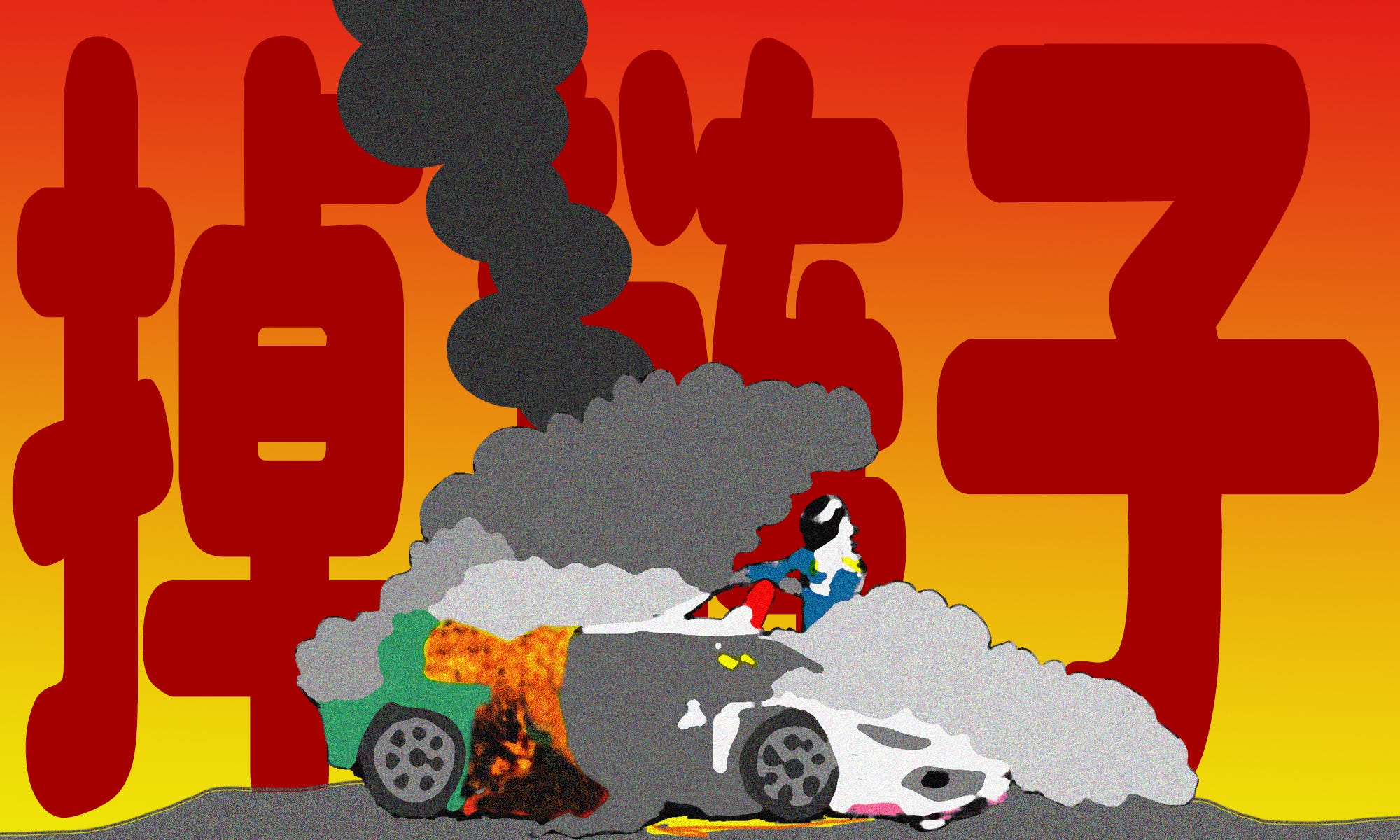
Shanghai hosted round four of this year’s China GT season on September 5. In the seventh lap of the race, cars 37 and 33 tangled and ran off the circuit. One of them struck car 91, which crashed and went up in flames with British driver Ollie Millroy trapped inside.
Ollie’s rival, Loek Hartog, a 23-year-old Dutchman, was close behind when the crash happened. He stopped, rushed out, and tried to tear the door off to get Millroy out of the burning vehicle. When that failed he took a fire extinguisher from a marshal who had just arrived. Hartog managed to calm the flames just enough for him to climb into the car and drag Millroy out. From the moment Hartog stopped to when Millroy was free took 49 seconds.
The British driver came out with five broken ribs, a broken collarbone, a broken hand and finger, burns, and a bruised lung.
Attention soon moved from Hartog’s heroics to the organisers’ incompetence:
“The accident brought out the very best in human nature.
But it also laid bare the organizer’s complete inaction for the whole world to see.”
一次事故让我们看到了人性最光辉的一面,但同样将赛事方的不作为完全暴露在公众的视野中。
That evening Millroy’s team, FIST Team AAI, condemned the race organiser for gross negligence. They accused them of not even having a handle on the basic facts. Because during the live broadcast of the race, officials had incorrectly said Millroy got out of the car himself.
Related


Accounts of the incident from other drivers were even more damning. Yang Baijie (杨百杰), who runs 610Racing and shares car 33, said the marshals panicked. Rather than moving towards the accident, they put down their extinguishers and fled. The ambulance took fifteen minutes to get to the scene, because its driver was asleep in the vehicle which was locked, so he couldn’t be woken for several minutes.
Footage from the scene also showed another marshal unable to get his extinguisher to work. A level of incompetence which is described in this colloquial phrase:
Why did the organiser ‘drop the chain’ when it came to the rescue?”
救援为什么掉了链子?
Trackside footage shows the first marshal carrying an extinguisher reached the scene 47 seconds after the crash, and handed it to Hartog, who was already at the car.
The organisers issued a statement the day after, apologising, thanking Hartog, and responding to the criticism:
“The overall setup meets national-level event standards.
But the finer details of management could be better.”
整个赛事的配置是符合国家级赛事配置的,但在细致管理方面有待提高。
“Finer details of management” is a typical face-saving way in Chinese to avoid taking blame for serious mistakes. And it’s that which turned this motorsport story into a national discussion, and how it was “a disgrace to Shanghai and to China” (丢上海的脸,丢中国的脸).
The organisers even tried to shift the responsibility onto the drivers. According to Yang Baijie, whose 610Racing car hit Millroy's in the crash, he and his drivers were called into the stewards' room after the race and urged to take the blame:
“What shocked me most was that the stewards’ first reaction was to try to pass the blame onto us.
They even asked if we could direct public criticism our way to take the heat off them.”
我很震惊仲裁的第一反应是尝试把责任推卸给我们,他们和我们沟通能否将舆论推向我们而去减轻他们的负面影响。
Ollie Millroy’s team, FIST Team AAI, has announced it’s pulling out of future China GT rounds, and has demanded a full, independent and public investigation into the incident.
Yang Baijie’s 610Racing, a Chinese team, has pulled out permanently. Other drivers have said they will follow, including Daniel Wu (吴彦祖), the Hong Kong actor and amateur racing driver, who has criticised the organisers publicly.
As Yang Baijie put it:
“When safety cannot be guaranteed, no title, no prize money and no podium is worth the risk.”
当生命安全无法得到保障时,冠军、奖金、舞台都不值得冒险。
And that’s what we’re exploring this week!
Favourite Five
1. 荒谬 huāng miù
absurd, ridiculous
更荒谬的是,另一位拿着灭火器的工作人员,甚至打不开灭火器 - Even more absurdly, another staff member holding a fire extinguisher couldn’t even open it. [3]
Related:
荒诞 huāng dàn – absurd, bizarre
2. 掉链子 diào liàn zi
to drop the ball, to mess up
车手在比赛中,救援为什么掉了链子 - The drivers were out there racing. So why did the organiser ‘drop the chain’ when it came to the rescue? [2]
3. 人命关天 rén mìng guān tiān
human life is at stake, human life is of the utmost importance
这难道不是人命关天的最关键底线? - Is safety not the single most non-negotiable of all? [3]
4. 厚颜无耻 hòu yán wú chǐ
shameless, brazen
我只想到4个字,厚颜无耻。如果必须再加4个字,那就是毫无底线 - I can only think of one word: shameless. If I had to add four more, it would be: absolutely no moral compass. [3]
5. 死里逃生 sǐ lǐ táo shēng
to escape death, a narrow escape
他的死里逃生和赛事救援团队无关 - His narrow escape from death had nothing to do with the race’s rescue team. [1]
💡 Want to close the gap between your rusty textbook Chinese and the real thing? 💡
The RTM Plus membership will help you do just that.
It gives you the tools, resources, and content you need to getg motivated, build a habit, and make real progress.
It including podcasts, app integrations, and much more and is ideal if your Chinese was once strong but has got rusty.
And you want to get your confidence back.
All while staying on top of what people in China are actually talking about right now.
Consuming the Conversation
Useful words
6. 自救 zì jiù
self-rescue, save oneself
是源于赛道上其他同行间的一次大义“自救” - It came down to a selfless rescue by his fellow racers on the track. [1]
7. 壮举 zhuàng jǔ
heroic feat, heroic deed
我只希望,在未来的世界里,这样的举动不再被视作什么英雄的壮举 - My only hope is that such an act will no longer be regarded as a heroic feat in the future. [1]
8. 失职 shī zhí
to neglect one’s duty, dereliction of duty
赛事组织方在现场应急处置、安全救援保障上存在严重失职 - The event organizers were seriously negligent in their emergency response and safety rescue measures. [1]
9. 惨剧 cǎn jù
tragedy, tragic incident
事故完全有可能发展成无法挽回的惨剧 - The accident could easily have turned into an irreversible tragedy. [1]


