


Welcome to RealTime Mandarin, a free weekly newsletter that helps you improve your Mandarin in 10 minutes a week.
Subscribe today to get your fluency back, stay informed about China, and communicate with confidence in Chinese — all through immersion in real news.
Unitree Robotics (宇树科技) is China’s leading maker of humanoid and quadruped robots. The Hangzhou-based company shot to fame in 2025, when its H1 robots performed a dance routine on CCTV’s Chinese New Year Gala show.
More recently, on 17 August 2026 Unitree released a demo video of a new robot called "Superman" (超人), recording a standing jump of about 2 metres and beating the human world record. The same video also showed Superman sprinting at a speed of 12.66 metres per second, faster than Usain Bolt's peak speed of 12.42 metres per second recorded in 2009.
The listing of Unitree on Shanghai’s STAR Market (科创板) has been one of the most anticipated IPOs of the year in China.
Two days after its Superman demo was released and went viral, the IPO bell rang in Shanghai on 19 August. Trading of its shares opened at 1,100 yuan a share (about $155), a 629% increase on the initial 150.8-yuan issue price (about $21). The market cap hit 444.9 billion yuan (about $62.7 billion) within minutes.
Investors were drawn by lottery from the 9.78 million who applied. Only 19,414 “winning” investors were selected to buy shares, each allotted the minimum allocation of 500 shares for 75,400 yuan. Once trading began, that same allocation was instantly worth 550,000 yuan, a paper profit of 474,600 yuan.
"Before Unitree listed, 'whether you'd win a lot' had already become something close to a lottery game.
在宇树上市前,“能不能中一签”已经成了一场近乎中彩票的游戏。 [1]
That made Unitree the most profitable opening of any listing since China’s registration-based IPO system began.
But it did not last. The share price soon tumbled from its peak, and by the close of the first day of trading, the market cap had dropped by 100 billion yuan to 341.8 billion. Its "turnover rate" (换手率) was 85%, meaning over four-fifths of the stock's entire tradable float changed hands in that single day of trading, a record for the STAR Market and a sign of fast, speculative trading.
The next four trading days brought no relief. By the end of the fifth day the share price had fallen to 606 yuan, and the market cap had tumbled to 245.2 billion yuan, wiping out more than 200 billion yuan from its peak valuation
Related


#240: Chinese AI chip maker briefly overtakes Moutai to become China’s most valuable listed company
The founder of Unitree is 36-year-old Wang Xingxing (王兴兴). He has already gained mythical status in China’s entrepreneurial world. He struggled through school in everything except mechanics and electronics. Once described by an English teacher as “a bit dim” (有点笨), he failed English so often it nearly cost him a place at Zhejiang University.
But he excelled in robotics, building his first bipedal robot for about 200 yuan as an undergraduate, and a quadruped robot, XDog, in graduate school.
His focus on cost cutting has defined how he runs the company. According to employees, any expense reimbursement over 100 yuan needs Wang’s personal approval. Wang himself has explained why:
“Cost has always been the KPI for everything we make.”
成本一直是我们做所有东西的KPI。
By the end of 2025, Unitree had just 516 employees, with Wang Xingxing simultaneously serving as chairman, general manager, and CTO, running a company that had been privately valued at 12.7 billion yuan just months earlier.
But it turns out his obsession with cost saving is one of the factors behind the sell-off in shares after the initial IPO spike.
Unitree's 2025 research and development spend was 145 million yuan, just 8.5% of its revenue that year, and well below the more than 23% of several of its peers. Online, people compared this low R&D spend to other sectors. With one entertaining example being pig farming group Muyuan Foods (牧原股份), which in 2025 spent 1.6 billion yuan on R&D, over ten times what Unitree spent:
“The R&D for robots doesn’t even match what goes into raising pigs.”
造机器人的研发还不如养猪。
Elsewhere, others noted that in the first half of 2026, Unitree’s sales expenses rose 250% year on year to 164 million yuan. An indication, according to critics, that its commercialisation is based around hype and expensive marketing stunts.
That criticism was further compounded by the fact that only 9% of Unitree’s humanoid robot revenue in the first three quarters of 2025 came from industrial applications, with 73% coming from “research and education” (科研教育) use cases. In plain terms, that means the robots are being bought mostly to be “looked at” (围观) rather than doing real work.
This highlights a deeper industry-wide challenge, which Wang Xingxing admitted himself at the World Robot Conference on August 20:
“Robots working in factories still aren’t efficient or adaptable enough”
机器人进工厂目前效率和泛用能力还是不够高。
So as one commentator put it, the danger was never that Unitree’s stock would fall. That was inevitable.
The bigger question, which the market soon corrected, was how it rose so much in the first place:
“Unitree’s overnight success as a Moutai-tier stock was nothing more than a flash in the pan.
Peaking the very moment it made its debut.”
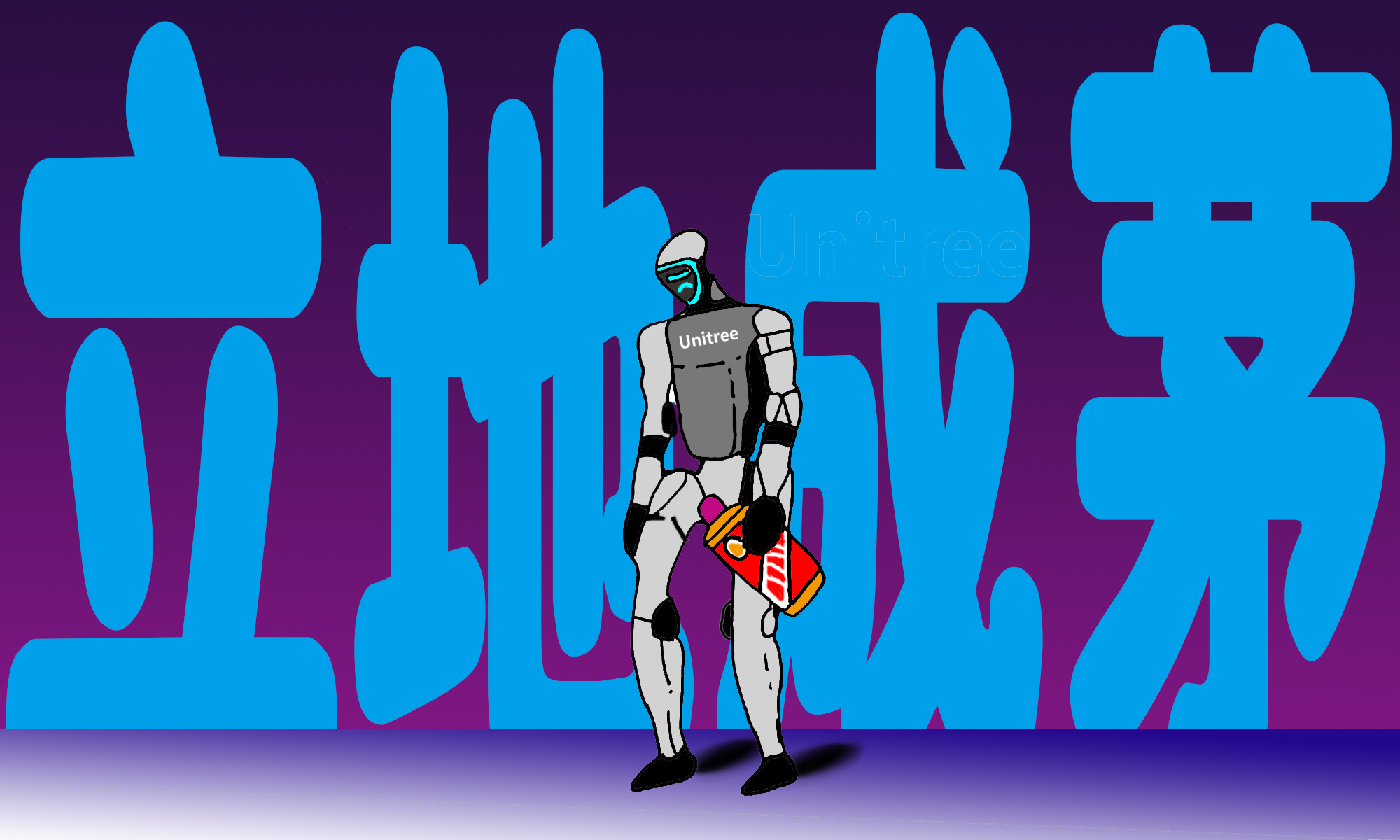
然而,宇树”立地成茅”只是出道即巅峰的昙花一现。
So that’s what we’re exploring this week!
Favourite Five
1. 自由落体 zì yóu luò tǐ
free fall
王兴兴“自黑”前的首个交易日,宇树股价已经处于“自由落体” - Even before Wang Xingxing’s pessmistic remarks, Unitree’s stock was already in free fall. [2]
2. 立地成茅 lì dì chéng máo
overnight success as a Moutai-tier stock, become a top-tier stock overnight
宇树“立地成茅”只是出道即巅峰的昙花一现 - Unitree’s overnight success as a Moutai-tier stock was nothing more than a flash in the pan, peaking the very moment it made its debut. [2]
3. 欲速则不达 yù sù zé bù dá
haste makes waste
但是,欲速则不达,该稳健的还是要稳健啊 - Haste makes waste, though—you still need to play it safe when it counts. [2]
4. 一片哀鸿 yí piàn āi hóng
a scene of widespread misery, widespread devastation
首日接盘的投资者一片哀鸿,埋怨宇树创始人王兴兴“瞎说大实话” - Investors who bought in on day one were left in tears, as they blamed Unitree founder Wang Xingxing for being brutally honest. [2]
5. 近水楼台先得月 jìn shuǐ lóu tái xiān dé yuè
those closest to the advantage benefit first, to have a favorable position
中国的制造业基础雄厚,高科技制造企业近水楼台先得月 - China has a strong manufacturing base, which gives domestic high-tech manufacturers a distinct home-court advantage. [2]
💡 Want to close the gap between your rusty textbook Chinese and the real thing? 💡
The RTM Plus membership will help you do just that.
It gives you the tools, resources, and content you need to getg motivated, build a habit, and make real progress.
It including podcasts, app integrations, and much more and is ideal if your Chinese was once strong but has got rusty.
And you want to get your confidence back.
All while staying on top of what people in China are actually talking about right now.
Consuming the Conversation
Useful words
6. 中签 zhòng qiān
be allocated shares in an IPO, get an IPO allocation
发行时中签率奇低,现在普遍在万分之一上下,认购者一签难求 - With winning odds practically ground down to 1 in 10,000 at launch, securing an IPO allotment was like striking gold. [3]
7. 腰斩 yāo zhǎn
be cut in half, lose half its value
市值的腰斩,更像是市场在上市首日一次性买进了太多年的未来,随后开始一点点往现实里找依据 - The halving of its market cap reflects a market that priced in years of future growth on day one, only to gradually ground itself back in reality. [1]
8. 蒸发 zhēng fā
evaporate, disappear
市值从4449亿到2452亿,蒸发超2000亿 - The market value fell from 444.9 billion to 245.2 billion, wiping out more than 200 billion. [2]
9. 黑料 hēi liào
damaging information, dirt
不需要内部人士爆料、自黑,“黑料”都在财报上写着呢 - You don’t need insider leaks or self-deprecating confessions, since the red flags are right there in the financial reports. [2]
10. 造势 zào shì
build momentum, generate hype
“人形机器人第一股”,是靠领先海内外同行的硬实力,还是擅长造势的营销能力? - Is the ‘first humanoid robotics stock’ driven by cutting-edge technology that outpaces domestic and global peers, or is it simply a masterclass in market hype? [2]
11. 阴跌 yīn diē
decline gradually, drift downward
A股市场新股以超低的中签率高价发行,然后更高价开盘,之后?当然就是长期反复阴跌了 - A-share IPOs price high on razor-thin allocation rates, pop even higher on debut, and then? Naturally a painful, drawn-out downward trend. [3]


